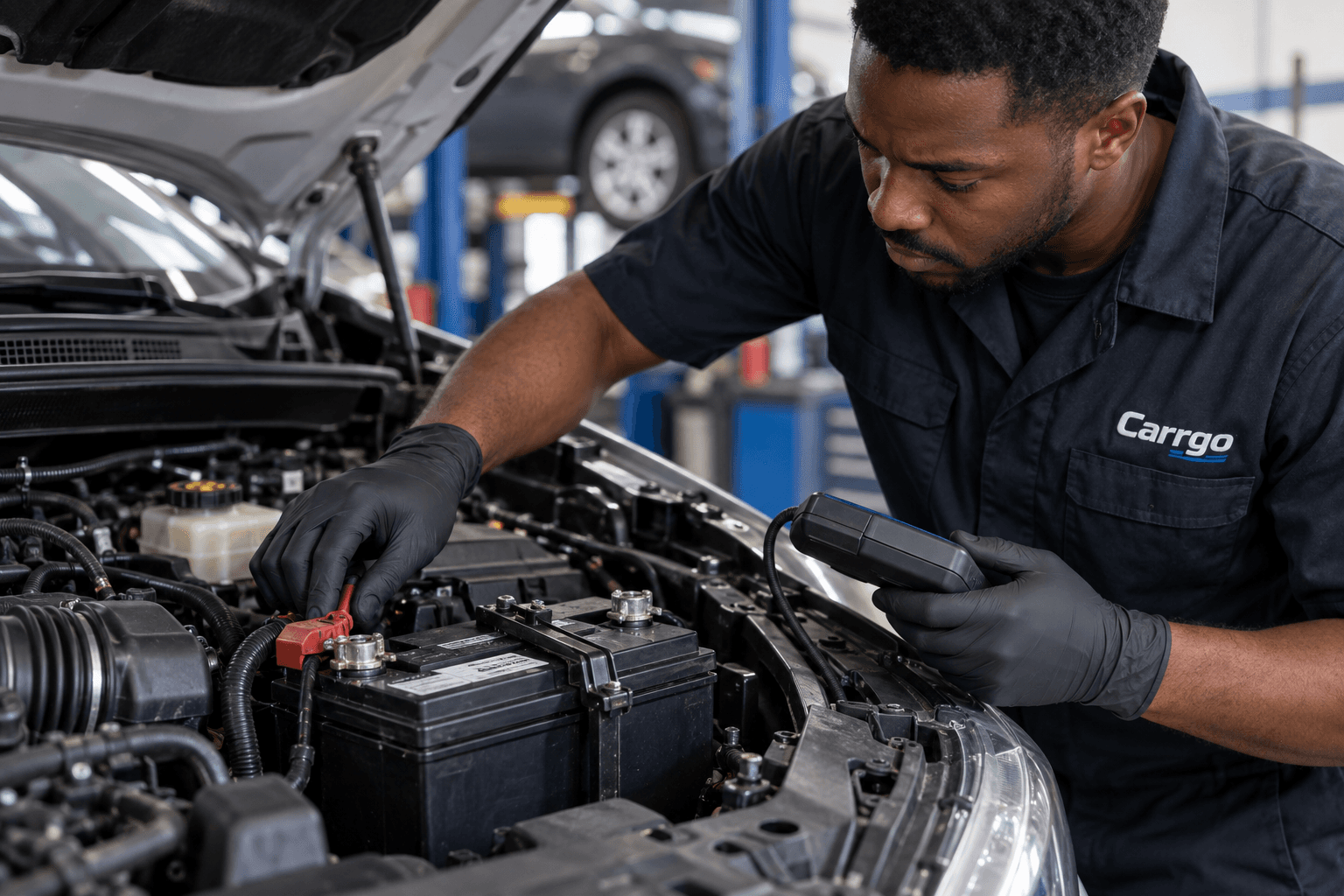
First, determine what the car is doing
When a car won't start, the first step is to determine whether the engine is cranking or not.
If the engine does not turn over when you attempt to start the vehicle, the problem may be related to the battery, starter system, wiring, or starting authorization.
If the engine turns over normally but does not start, the diagnostic process moves toward fuel, ignition, air, engine-management, immobilizer, and mechanical systems.
1. Check the battery
A weak or discharged battery is one of the most common reasons a vehicle will not start.
A battery can still power dashboard lights and accessories while being too weak to provide enough current for the starter motor.
- Slow engine cranking
- Clicking when attempting to start
- Dim dashboard or interior lights
- Weak headlights
- Electrical accessories becoming weak
- Difficulty starting after the vehicle has been parked
2. Check the starter system
If the battery has sufficient power but the engine does not crank, the starting circuit should be investigated.
The starter motor, starter relay, fuses, wiring, grounds, ignition switch or start button, and starting control signals may all need to be checked.
- Starter motor
- Starter relay
- Starting-system fuses
- Battery terminals
- Engine and chassis grounds
- Starter power supply
- Starter control signal
3. Check the key and immobilizer system
Modern vehicles may prevent the engine from starting when the immobilizer system does not recognize or authorize the key.
A security warning light, key-not-detected message, damaged key, weak key-fob battery on applicable systems, or communication problem can sometimes be involved.
- Check for an immobilizer or security warning
- Try the spare key when available
- Check for a key-not-detected message
- Check the vehicle battery voltage
- Have the security system scanned when necessary
4. Check fuel and ignition
If the engine cranks normally but refuses to start, fuel delivery and ignition should be investigated.
The engine needs the correct combination of air, fuel, ignition, and engine-control signals to start and continue running.
- Fuel level and fuel delivery
- Fuel pump operation
- Fuel pressure
- Fuel injector operation
- Ignition spark
- Ignition coils
- Relevant engine sensors
5. Check the vehicle with a diagnostic scanner
Modern vehicles can store diagnostic information when a control module detects a problem.
A diagnostic scan can provide useful information about the systems that need further testing, especially when the cause of the no-start condition is not obvious.
A scan should be used as part of a proper diagnostic process rather than as a reason to replace a component immediately.
Crank-no-start and no-crank are different problems
This distinction is important when diagnosing a starting problem.
A no-crank condition means the engine is not being turned by the starter motor.
A crank-no-start condition means the starter is turning the engine, but the engine is not successfully starting.
Do not replace parts without testing
A vehicle that will not start can have an electrical, fuel, ignition, security, sensor, wiring, or mechanical problem.
Replacing the battery, starter, fuel pump, or sensors without confirming the fault can waste money and may not solve the problem.
A systematic diagnosis is the safest way to identify the actual cause.
Carrgo Technician Tip
When a car won't start, start with one simple question: DOES IT CRANK?
If it does not crank, investigate the starting system. If it cranks but does not start, investigate fuel, spark, air, engine-management, immobilizer, and mechanical conditions.