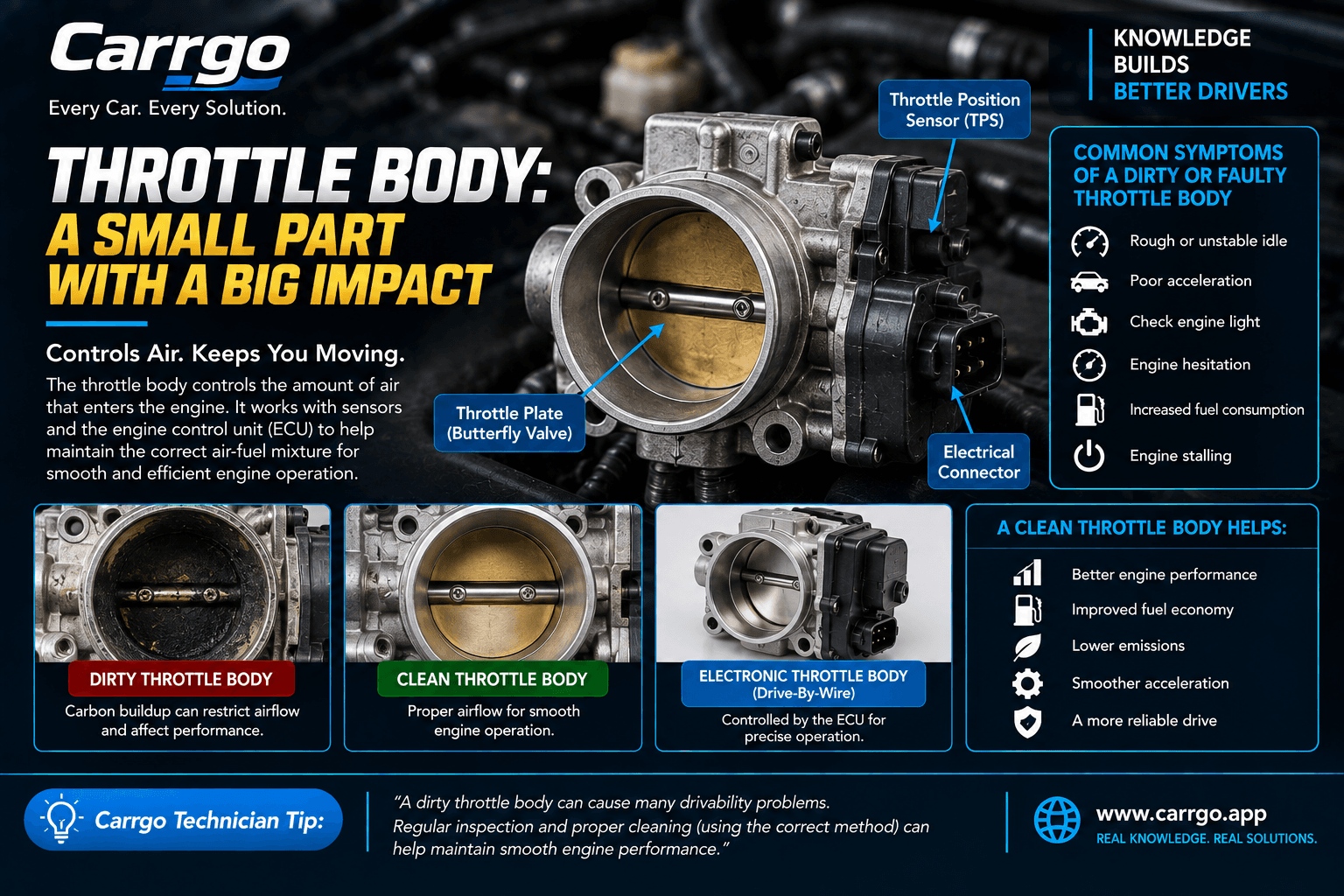
What is a throttle body?
The throttle body controls the amount of air entering the engine. It contains a throttle plate that opens and closes according to the driver's demand and the vehicle's engine-management strategy.
Modern vehicles commonly use electronic throttle control, where the engine control system manages throttle operation using electronic signals.
Why is the throttle body important?
The amount of air entering the engine directly affects engine operation. The throttle body therefore plays an important role in acceleration, idle control, and overall engine response.
A properly functioning throttle body allows the engine-management system to control airflow accurately.
Common signs of a dirty or faulty throttle body
- Rough or unstable idle
- Poor acceleration
- Engine hesitation
- Reduced engine performance
- Engine stalling
- Difficulty maintaining idle
- Increased fuel consumption
- Check engine light
- Reduced throttle response
Why does a throttle body become dirty?
Oil vapour and deposits from the engine's intake system can gradually build up around the throttle plate and throttle-body bore.
The amount of buildup depends on the engine design, ventilation system, vehicle condition, and operating environment.
- Carbon and deposit buildup
- Oil vapour from the crankcase ventilation system
- Dust or contamination entering the intake system
- Long service intervals
- Problems elsewhere in the intake system
How can dirt affect the throttle body?
Heavy deposits around the throttle plate can affect airflow, particularly when the throttle is nearly closed.
This may contribute to unstable idle, hesitation, or poor throttle response on some vehicles.
Electronic throttle bodies need proper diagnosis
Electronic throttle systems use motors, position sensors, wiring, connectors, and the engine control system to control throttle operation.
A throttle-related symptom does not automatically mean that the throttle body itself has failed.
- Throttle position sensor signals
- Throttle actuator operation
- Electrical power and ground
- Wiring and connectors
- Engine control module commands
- Related diagnostic information
Can you clean a throttle body?
Some throttle bodies can be cleaned as part of normal service, but the correct procedure depends on the vehicle and throttle-body design.
Care must be taken with electronic throttle components and sensors. Do not force the throttle plate or use cleaning methods that are not approved for the particular unit.
Throttle-body cleaning may require relearning
Some electronically controlled vehicles may require an idle or throttle-position relearn after throttle-body cleaning, replacement, battery disconnection, or other service procedures.
The exact procedure varies by vehicle, so the manufacturer's service information should be followed.
A throttle-body problem is not always the throttle body
Poor idle, hesitation, and reduced acceleration can also be caused by vacuum leaks, airflow sensors, ignition problems, fuel-system faults, wiring problems, or other engine-management issues.
Proper diagnosis helps identify the actual cause instead of replacing parts based only on symptoms.
Carrgo Technician Tip
A dirty throttle body can affect how smoothly an engine breathes at low throttle openings.
Before replacing the throttle body, inspect it properly, check its electrical system, and rule out other causes of the vehicle's symptoms.