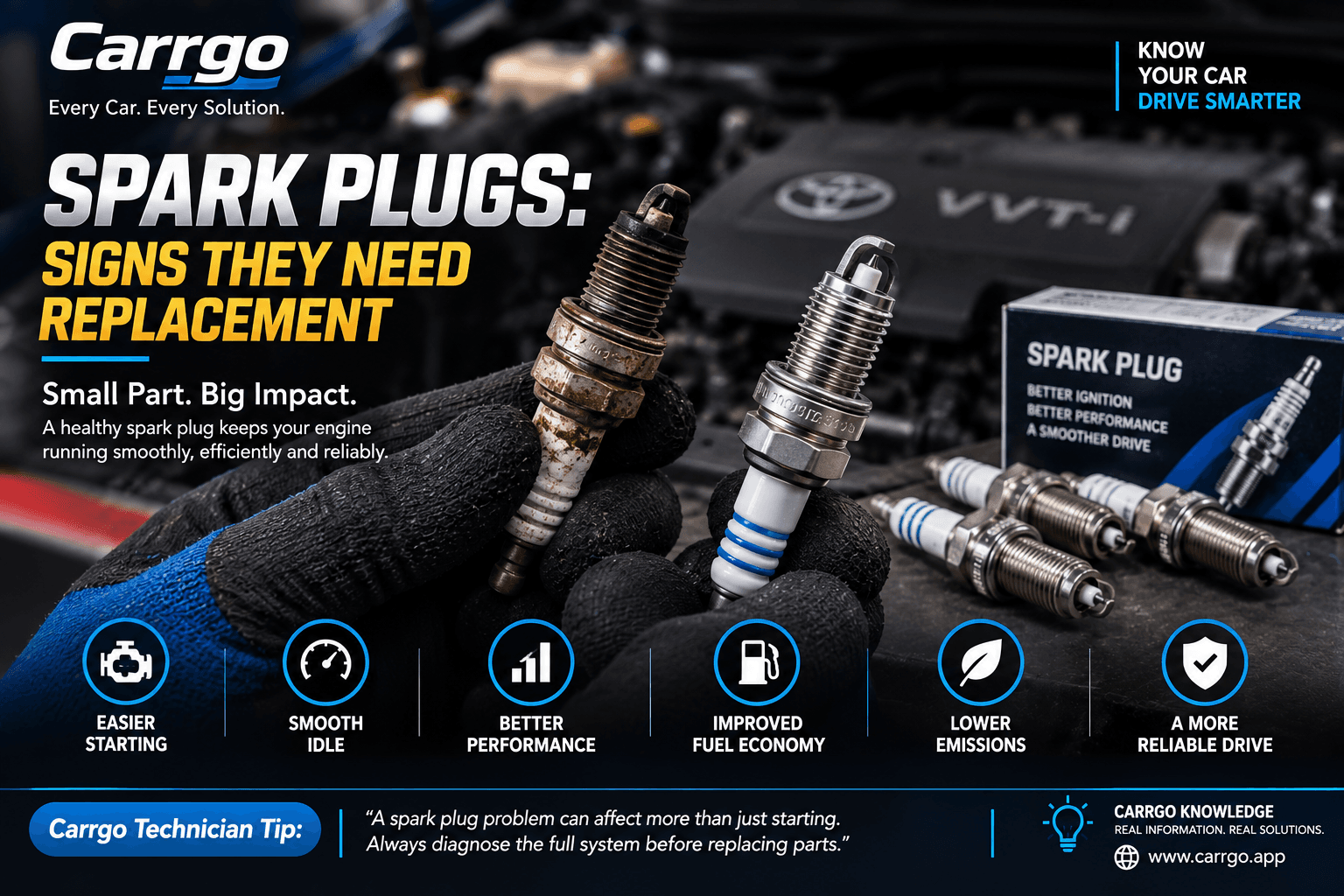
What does a spark plug do?
A spark plug creates the electrical spark needed to ignite the air-fuel mixture inside a gasoline engine cylinder.
The ignition system delivers high voltage to the spark plug, allowing it to produce a controlled spark across its electrode gap.
A properly functioning spark plug is important for smooth combustion, engine performance, starting, and fuel efficiency.
Signs your spark plugs may be worn
- Hard starting
- Rough or unstable engine idle
- Engine hesitation
- Poor acceleration
- Engine misfire
- Reduced engine performance
- Increased fuel consumption
- Difficulty starting the engine
- Check engine light
What can cause spark plug problems?
Spark plugs gradually wear as they operate under high temperature and electrical stress. Their condition can also be affected by problems elsewhere in the engine.
Oil contamination, excessive fuel, incorrect air-fuel mixture, overheating, or other engine conditions can change the appearance and performance of a spark plug.
- Normal electrode wear
- Oil contamination
- Fuel fouling
- Carbon deposits
- Incorrect spark plug type
- Incorrect spark plug gap
- Engine oil entering the combustion chamber
- Fuel mixture problems
- Ignition-system problems
Why spark plug inspection matters
Removing and inspecting the spark plugs can provide useful information about the condition of the ignition and combustion system.
The appearance of a spark plug can sometimes provide clues about oil consumption, fuel mixture, combustion conditions, or other engine problems.
Do all spark plugs need to be replaced at the same time?
For vehicles that use a set of matching spark plugs, replacement is commonly performed according to the manufacturer's recommended service interval.
The correct replacement interval depends on the vehicle, engine, spark plug design, and manufacturer specifications.
Always use the correct spark plug specification for the particular engine.
Spark plug gap is important
The distance between the spark plug electrodes affects how the ignition system produces the spark.
Using the wrong gap can affect ignition performance and may cause starting, misfire, or drivability problems.
The correct gap should follow the vehicle manufacturer's specification or the specification provided for the exact spark plug application.
A bad spark plug is not the only cause of a misfire
An engine misfire can have many possible causes. A faulty spark plug is only one possibility.
Ignition coils, injectors, fuel pressure, intake leaks, engine compression, wiring, timing, and other systems can also contribute to a misfire.
Replacing spark plugs without identifying the actual cause may not solve the problem.
When should you replace spark plugs?
Follow the vehicle manufacturer's maintenance schedule and the specification for the installed spark plugs.
Spark plugs should also be inspected when the vehicle develops symptoms such as repeated misfires, hard starting, poor acceleration, or unusual engine performance.
Carrgo Technician Tip
Don't judge a spark plug only by how old it looks.
Check the correct plug specification, electrode condition, gap, and combustion appearance—and if there is an engine misfire, diagnose the complete ignition, fuel, air, and mechanical systems before replacing parts.