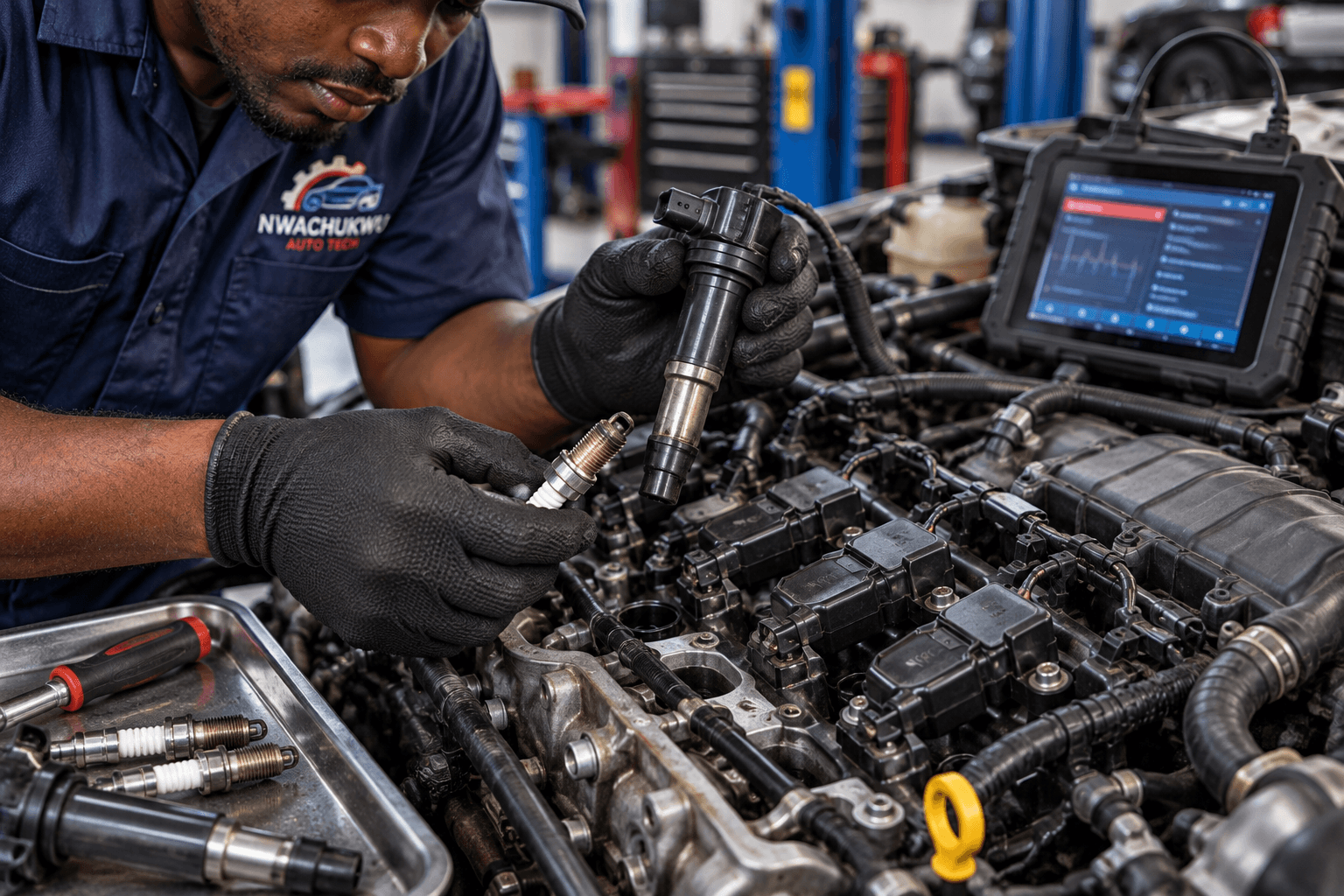
What does P0310 mean?
P0310 indicates that the engine control system has detected a misfire on cylinder 10.
A misfire occurs when cylinder 10 does not properly burn the air-fuel mixture during combustion. The problem can be related to ignition, fuel delivery, air intake, compression, engine timing, or an electrical fault.
The code identifies cylinder 10 as the cylinder where the misfire was detected, but it does not automatically identify which component has failed.
Common symptoms
- Rough or unstable idle
- Engine shaking or vibration
- Hesitation during acceleration
- Loss of engine power
- Poor acceleration
- Increased fuel consumption
- Engine stumbling
- Difficult starting
- Engine stalling
- Check engine light
- Flashing check engine light during severe misfire
Common causes of P0310
- Worn or fouled spark plug on cylinder 10
- Faulty ignition coil
- Faulty or clogged fuel injector
- Injector wiring or connector fault
- Ignition coil wiring or connector fault
- Vacuum or intake air leak
- Low fuel pressure
- Low compression on cylinder 10
- Burnt or leaking valve
- Damaged piston or piston rings
- Head-gasket problem
- Incorrect engine timing
- Crankshaft or camshaft signal problems
- Poor-quality or contaminated fuel
How should P0310 be diagnosed?
Start by confirming the trouble code with a diagnostic scanner and checking for additional codes. Other cylinder-specific misfire codes and fuel-trim codes can provide useful diagnostic clues.
Confirm the cylinder numbering for the specific engine before testing. Cylinder numbering can vary between engine designs and manufacturers.
- Inspect the cylinder 10 spark plug
- Check the cylinder 10 ignition coil
- Inspect ignition wiring and connectors
- Test the cylinder 10 fuel injector
- Check injector wiring and control
- Inspect for intake or vacuum leaks
- Check fuel pressure when necessary
- Monitor misfire counters and live data
- Perform a compression test when required
- Perform a leak-down test if compression is low
- Check engine timing when necessary
Test the ignition coil before replacing it
If the vehicle uses interchangeable ignition coils, a technician may swap the cylinder 10 coil with another cylinder and monitor the misfire data.
If the misfire moves to the cylinder receiving the suspected coil, the ignition coil becomes a strong suspect. This type of component testing should be performed according to the vehicle manufacturer's diagnostic procedure.
Check the cylinder 10 fuel injector
A faulty fuel injector can cause cylinder 10 to misfire by delivering too much fuel, too little fuel, or no fuel.
Check the injector's electrical circuit, connector, control signal, and operation before replacing it. Fuel pressure and overall fuel delivery should also be considered when necessary.
Check engine compression
If the ignition and fuel systems appear to be functioning correctly, perform a compression test and compare cylinder 10 with the other cylinders.
Low compression may indicate a valve problem, piston or piston-ring problem, head-gasket failure, or another internal engine fault.
Check for intake and vacuum leaks
An air leak near cylinder 10 can create an incorrect air-fuel mixture and contribute to a misfire.
Inspect the intake manifold, gaskets, vacuum hoses, PCV system, and other nearby intake components.
Do not replace parts based only on P0310
P0310 identifies cylinder 10 as the cylinder where the misfire was detected. It does not automatically prove that the spark plug, ignition coil, injector, or another component has failed.
A proper diagnosis should check spark, fuel, air, compression, timing, and electrical circuits before replacing expensive components.
Is P0310 serious?
P0310 can be serious when the misfire is continuous or severe. A severe misfire can allow unburned fuel to enter the exhaust system and may cause excessive heat and catalytic-converter damage.
If the check engine light is flashing or the engine is running very badly, the vehicle should be diagnosed promptly.
Can you drive with P0310?
Avoid prolonged driving while the engine is actively misfiring.
If the engine is shaking severely, losing significant power, stalling, or the check engine light is flashing, stop driving when it is safe to do so and have the vehicle properly diagnosed.
Carrgo Technician Tip
P0310 is a diagnostic starting point, not a parts-replacement command.
Before replacing components, systematically check SPARK, FUEL, AIR, COMPRESSION, TIMING, and the related electrical circuits.
Related OBD-II trouble codes
- P0300 — Random/Multiple Cylinder Misfire Detected
- P0301 — Cylinder 1 Misfire Detected
- P0302 — Cylinder 2 Misfire Detected
- P0303 — Cylinder 3 Misfire Detected
- P0304 — Cylinder 4 Misfire Detected
- P0305 — Cylinder 5 Misfire Detected
- P0306 — Cylinder 6 Misfire Detected
- P0307 — Cylinder 7 Misfire Detected
- P0308 — Cylinder 8 Misfire Detected
- P0309 — Cylinder 9 Misfire Detected
- P0311 — Cylinder 11 Misfire Detected
- P0171 — System Too Lean
- P0172 — System Too Rich