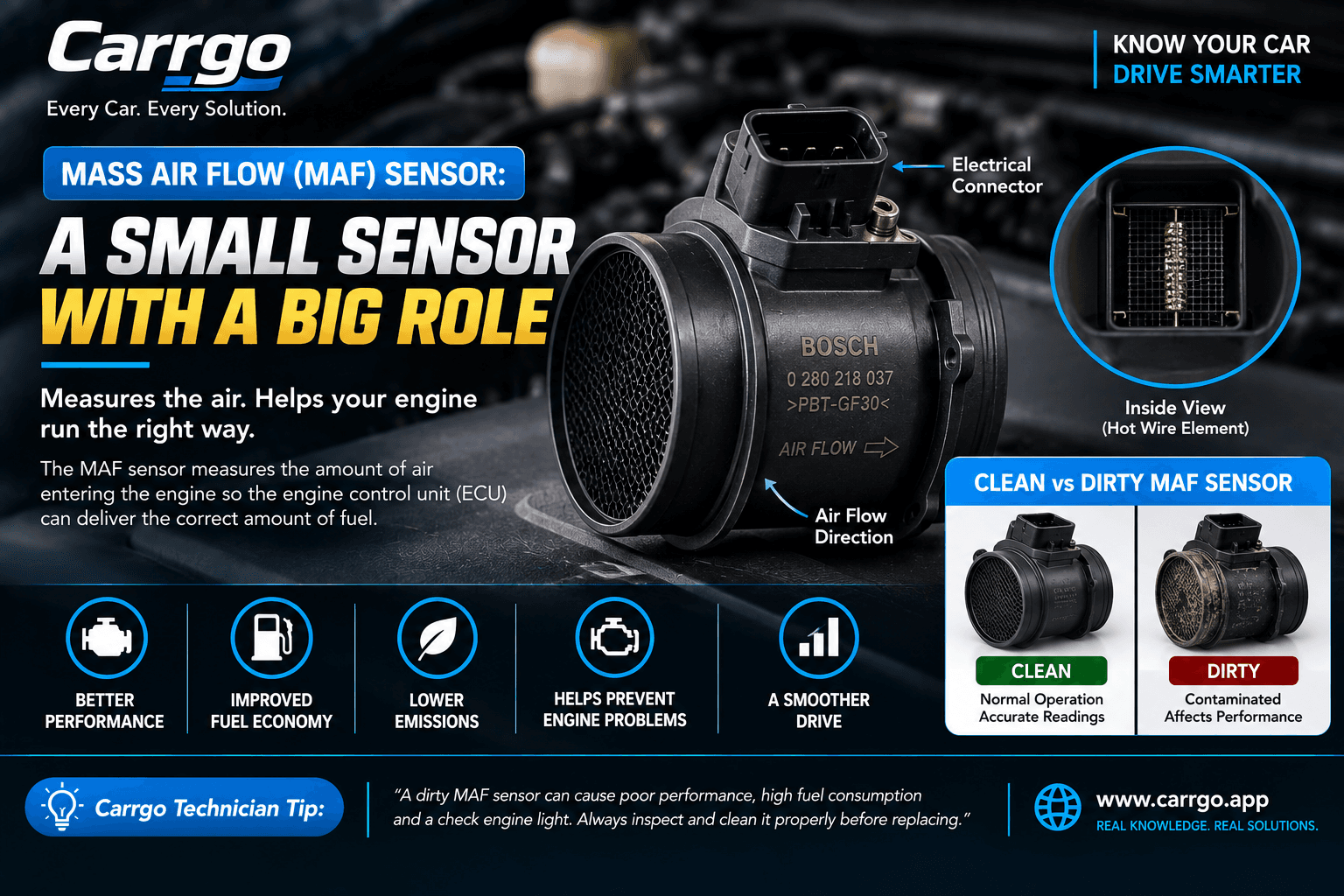
What is a Mass Air Flow sensor?
The Mass Air Flow sensor, commonly called the MAF sensor, measures the amount of air entering the engine.
The engine control unit uses this information to help determine how much fuel is needed for the engine to operate correctly.
Why is the MAF sensor important?
Modern engine-management systems depend on accurate airflow information to calculate and control engine operation.
If the MAF sensor provides an inaccurate reading, the engine control system may receive incorrect information about the amount of air entering the engine.
Common signs of a MAF sensor problem
- Poor engine performance
- Hesitation during acceleration
- Rough or unstable idle
- Hard starting
- Engine stalling
- Reduced acceleration
- Increased fuel consumption
- Check engine light
- Engine running too rich or too lean
- Reduced engine response
What can cause MAF sensor problems?
The sensing element inside a MAF sensor can become contaminated, and the sensor or its circuit can also develop electrical or mechanical problems.
Problems elsewhere in the air-intake system can also affect MAF readings and produce similar symptoms.
- Dust or contamination
- Oil contamination from the intake system
- Damaged sensor element
- Faulty electrical connector
- Damaged wiring
- Incorrect power or ground supply
- Air leaks after the MAF sensor
- Incorrectly installed air filter or intake components
A dirty MAF sensor can affect engine performance
Contamination on the sensing element can interfere with the sensor's ability to measure incoming air accurately.
This may contribute to poor engine response, rough running, fuel-economy problems, or other drivability symptoms.
An air leak can look like a MAF problem
The MAF sensor measures the air that passes through it. If unmetered air enters the engine after the sensor, the engine may receive more air than the control system expects.
This can create symptoms that appear similar to a faulty MAF sensor, even though the sensor itself may be working correctly.
How is a MAF sensor diagnosed?
A proper diagnosis should evaluate the MAF sensor, its electrical circuit, and the air-intake system rather than relying on symptoms alone.
- Check for diagnostic information
- Inspect the MAF sensor and connector
- Check sensor power and ground where applicable
- Inspect MAF signal wiring
- Check live-data readings
- Inspect the air filter and intake system
- Check for unmetered-air or vacuum leaks
- Compare sensor readings with expected operating conditions
- Check related fuel-trim information where available
Should you clean a MAF sensor?
Some MAF sensors can be carefully cleaned using a cleaning product specifically designed for MAF sensors.
Do not use aggressive solvents or physically touch the delicate sensing element unless the manufacturer's service procedure specifically allows it.
If the sensor has an internal electrical or electronic failure, cleaning it will not repair the failed component.
Do not replace the MAF sensor just because of a fault code
A MAF-related diagnostic code does not automatically prove that the MAF sensor itself has failed.
Wiring problems, connector faults, intake leaks, contamination, incorrect air-filter installation, and other engine-management problems can produce similar symptoms.
Proper testing should be performed before replacing the sensor.
Carrgo Technician Tip
The MAF sensor is the engine's airflow information source.
If the reading is wrong, the engine control system may make the wrong decisions about fuel and engine operation. Always check the sensor, its wiring, and the complete intake system before replacing it.