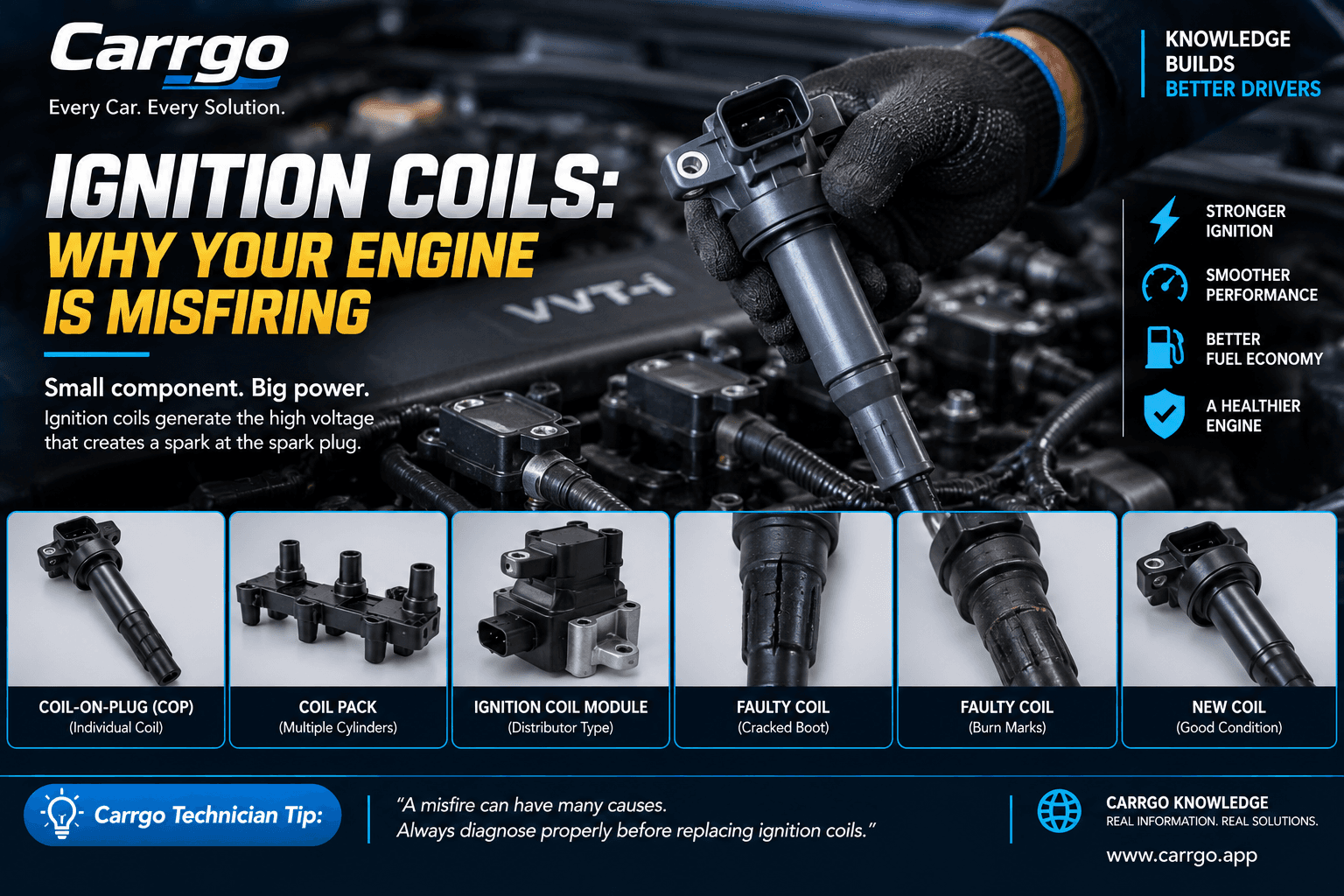
What is an ignition coil?
An ignition coil is an important part of the ignition system in a gasoline engine. Its job is to transform the vehicle's relatively low battery voltage into the high voltage needed to create a spark at the spark plug.
Depending on the vehicle design, an engine may use one ignition coil for several cylinders or an individual coil for each spark plug.
Why are ignition coils important?
The ignition system must produce a strong and correctly timed spark to ignite the air-fuel mixture inside the cylinder.
When an ignition coil cannot produce the required spark, the affected cylinder may misfire and the engine may run poorly.
Common signs of a faulty ignition coil
- Engine misfire
- Rough or unstable idle
- Engine shaking or vibration
- Hesitation during acceleration
- Poor acceleration
- Loss of engine power
- Hard starting
- Engine stalling
- Increased fuel consumption
- Check engine light
What can cause an ignition coil to fail?
Ignition coils operate under high electrical and thermal stress. Over time, heat, vibration, electrical problems, moisture, or other engine conditions can contribute to coil failure.
A coil can also be affected by problems in the ignition circuit or by another fault that places abnormal stress on the ignition system.
- Age and normal wear
- Excessive engine heat
- Moisture or oil contamination
- Damaged wiring or connectors
- Incorrect electrical supply
- Poor spark plug condition
- Incorrect spark plug gap
- Internal coil failure
A misfire does not always mean the ignition coil is bad
An engine misfire can have many possible causes. Spark plugs, fuel injectors, fuel pressure, intake leaks, engine compression, wiring, timing, and other systems can produce similar symptoms.
This is why replacing an ignition coil simply because the engine is misfiring can lead to unnecessary parts replacement.
How do technicians diagnose an ignition coil?
Diagnosis depends on the vehicle's ignition-system design. A technician may combine scan data, visual inspection, electrical testing, and component testing to determine whether the coil is actually responsible for the misfire.
- Scan for diagnostic information
- Identify which cylinder is misfiring
- Inspect the ignition coil and connector
- Inspect the spark plug
- Check the coil's power supply and ground where applicable
- Check ignition control signals where applicable
- Monitor engine misfire data
- Test or swap interchangeable coils when appropriate
- Check fuel and mechanical systems if necessary
Why swapping ignition coils can help diagnosis
On vehicles with interchangeable individual ignition coils, a technician may move a suspected coil to another cylinder and monitor the misfire information.
If the misfire follows the coil, the coil becomes a strong suspect. This type of test should be performed according to the vehicle manufacturer's diagnostic procedure.
Can a bad ignition coil damage other components?
A severe or continuous engine misfire can allow unburned fuel to enter the exhaust system. Depending on the vehicle and operating conditions, this can cause excessive heat and damage to the catalytic converter.
A flashing check engine light can indicate a severe misfire condition that requires prompt attention.
When should you replace an ignition coil?
An ignition coil should be replaced when testing confirms that it has failed or when the manufacturer's diagnostic procedure identifies it as the cause of the problem.
If one coil fails, do not automatically assume that every other coil needs replacement. The correct approach depends on the vehicle manufacturer's recommendations and the condition of the remaining components.
Carrgo Technician Tip
A misfire is a symptom, not a parts-replacement instruction.
Before replacing an ignition coil, confirm the affected cylinder and test the ignition, fuel, air, mechanical, and electrical systems that could produce the same symptom.