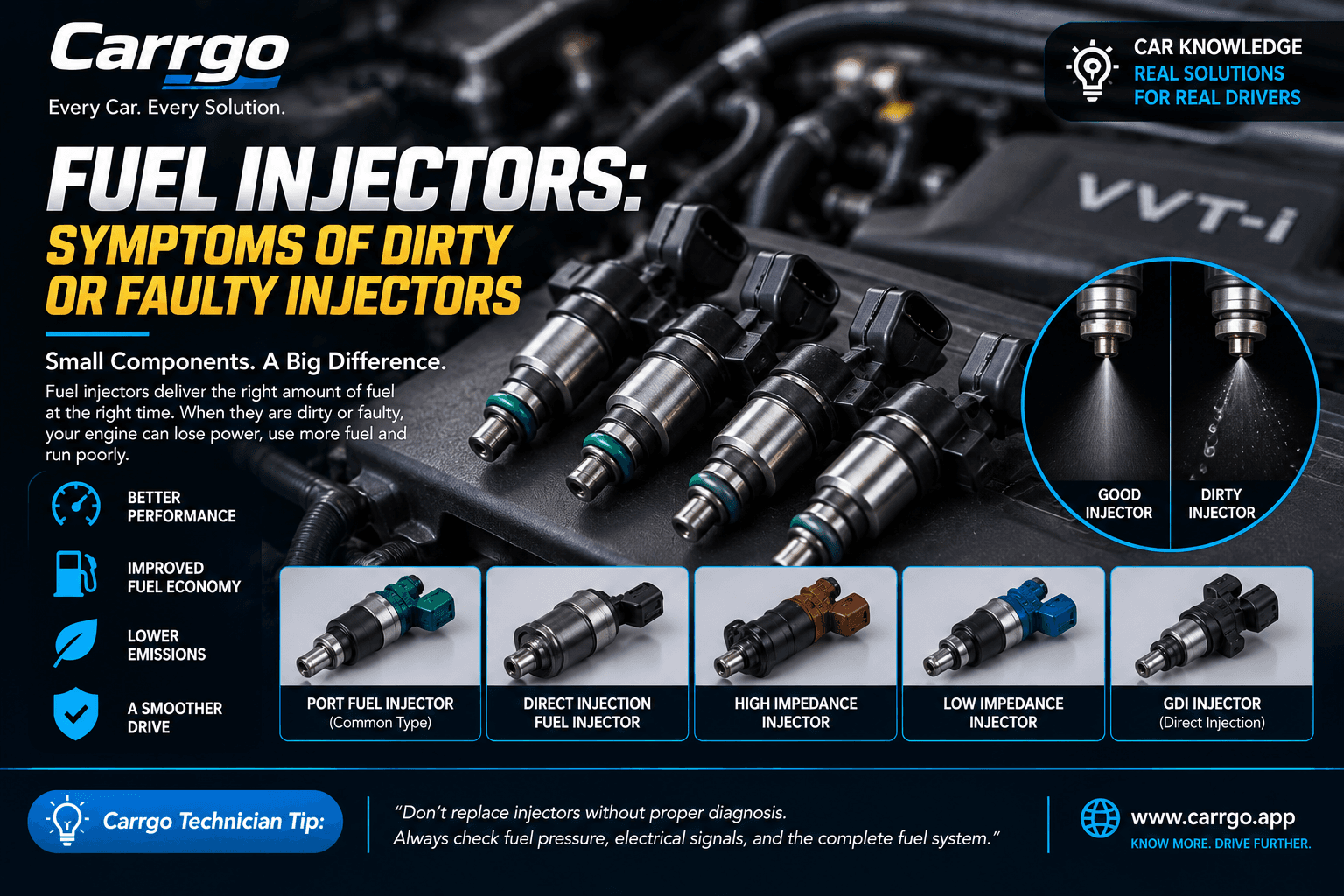
What is a fuel injector?
A fuel injector is a component that delivers fuel into an engine's intake system or combustion chamber, depending on the engine design.
The injector must deliver the correct amount of fuel at the correct time so the engine can maintain the required air-fuel mixture.
Why are fuel injectors important?
The engine depends on accurate fuel delivery for starting, smooth combustion, acceleration, power, and efficient operation.
If an injector becomes restricted, leaks, or develops an electrical or mechanical fault, the engine may not receive the correct amount of fuel.
Common symptoms of injector problems
- Rough or unstable engine idle
- Engine misfire
- Hard starting
- Engine hesitation
- Poor acceleration
- Loss of engine power
- Increased fuel consumption
- Engine stalling
- Fuel odor
- Check engine light
What can cause a fuel injector problem?
Fuel injectors operate under demanding conditions and can be affected by contamination, electrical faults, fuel-system problems, or normal wear.
The exact cause depends on the injector design and the vehicle's fuel system.
- Fuel contamination
- Restricted injector nozzle
- Internal injector failure
- Injector electrical-circuit fault
- Damaged injector connector
- Low or incorrect fuel pressure
- Poor-quality fuel
- Fuel-system contamination
Dirty injectors can affect engine performance
A restricted injector may not deliver the expected amount of fuel. This can affect combustion and may cause hesitation, rough running, reduced power, or a misfire.
However, similar symptoms can be caused by ignition, air-intake, sensor, or mechanical problems, so injector cleaning should not automatically be assumed to be the solution.
A leaking injector can cause different symptoms
An injector that does not close correctly may deliver too much fuel. Depending on the vehicle and severity of the problem, this can cause poor running, difficult starting, increased fuel consumption, fuel odor, or other drivability problems.
A leaking injector should be properly diagnosed because excessive fuel delivery can affect engine operation and emissions.
How are fuel injectors diagnosed?
Proper injector diagnosis depends on the vehicle's fuel-system design. A technician may combine scan data, electrical testing, fuel-pressure testing, injector testing, and engine-performance information.
- Check for diagnostic information
- Inspect injector wiring and connectors
- Verify injector power and control circuit where applicable
- Check fuel pressure
- Monitor engine fuel-trim and misfire data where available
- Test injector operation
- Compare injector performance when appropriate
- Check for fuel leakage when required
Does an injector problem always mean the injector needs replacement?
No. An injector-related symptom does not automatically prove that the injector itself has failed.
Electrical wiring, connectors, fuel pressure, fuel supply, engine-management signals, and other engine problems can produce similar symptoms.
Testing the complete fuel-delivery system helps prevent unnecessary injector replacement.
Should you clean your fuel injectors?
Injector cleaning may be appropriate in some situations, but the correct procedure depends on the injector and fuel-system design.
If an injector has an electrical or internal mechanical failure, cleaning may not repair it.
A proper diagnosis should determine whether cleaning, testing, repair, or replacement is appropriate.
Carrgo Technician Tip
Don't blame the injector simply because an engine is misfiring or using too much fuel.
Check FUEL PRESSURE, INJECTOR OPERATION, ELECTRICAL CONTROL, AIR-FUEL MIXTURE, IGNITION, and ENGINE CONDITION before replacing expensive components.