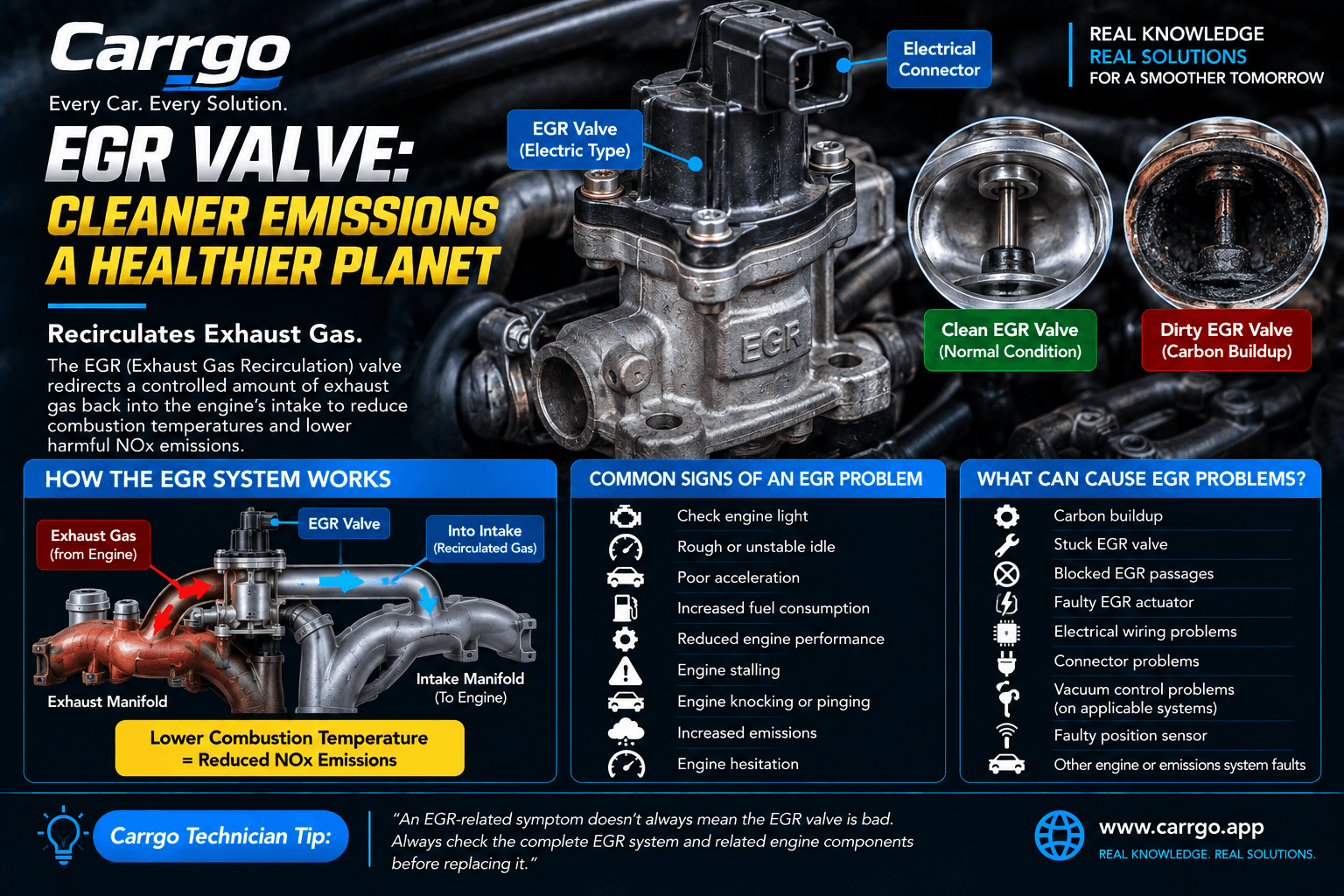
What is an EGR valve?
EGR stands for Exhaust Gas Recirculation. The EGR system redirects a controlled amount of exhaust gas back into the engine's intake under specific operating conditions.
This helps reduce combustion temperatures and can reduce the formation of nitrogen oxides (NOx).
Why is the EGR system important?
The EGR system is part of the vehicle's emissions-control strategy. By recirculating a controlled amount of exhaust gas, it can help control combustion conditions and reduce certain harmful emissions.
The exact operation of the EGR system varies between vehicle and engine designs.
Common signs of an EGR problem
- Rough or unstable idle
- Engine hesitation
- Poor acceleration
- Reduced engine performance
- Engine stalling
- Increased fuel consumption
- Check engine light
- Engine knocking or pinging
- Increased emissions
Why does an EGR valve become dirty?
Exhaust gas contains soot and other combustion by-products. Over time, deposits can accumulate inside the EGR valve and related passages.
Heavy carbon buildup can interfere with the valve's movement or restrict the passages through which exhaust gas flows.
What happens when the EGR valve sticks open?
If the EGR valve remains open when it should be closed, too much exhaust gas may enter the intake during conditions where EGR flow is not expected.
Depending on the engine design, this can contribute to rough idle, hesitation, poor performance, or stalling.
What happens when the EGR valve does not open?
If the EGR system cannot provide the expected amount of exhaust-gas recirculation, emissions may increase and the engine control system may detect an EGR-related fault.
The symptoms depend on the vehicle's control strategy and the underlying cause.
What can cause EGR problems?
- Carbon buildup
- Stuck EGR valve
- Blocked EGR passages
- Faulty EGR actuator
- Electrical wiring problems
- Connector problems
- Vacuum-control problems on applicable systems
- Faulty position sensor where applicable
- Other engine or emissions-system problems
How is an EGR problem diagnosed?
A proper diagnosis should determine whether the valve, control circuit, passages, or another engine condition is responsible for the symptoms.
- Check diagnostic information
- Inspect the EGR valve and connector
- Check electrical power and ground where applicable
- Check control signals
- Monitor EGR-related live data where available
- Inspect for carbon buildup
- Check EGR passages
- Test valve operation according to the vehicle's service procedure
Can an EGR valve be cleaned?
Some EGR valves and passages can be cleaned when carbon buildup is the cause of the problem.
However, cleaning cannot repair an electrical or internal mechanical failure. The correct cleaning procedure depends on the vehicle and EGR-system design.
Do not replace the EGR valve without diagnosis
An EGR-related symptom does not automatically mean that the EGR valve itself has failed.
Wiring faults, blocked passages, vacuum problems, sensor faults, and other engine conditions can produce similar symptoms.
Carrgo Technician Tip
If an EGR system is causing problems, don't just replace the valve because it is dirty or because a diagnostic code points in its direction.
Inspect the valve, passages, control circuit, and related engine systems to find the real cause before replacing parts.