What is a car sensor?
A vehicle sensor is an electronic device that measures a condition or value and sends information to a control module.
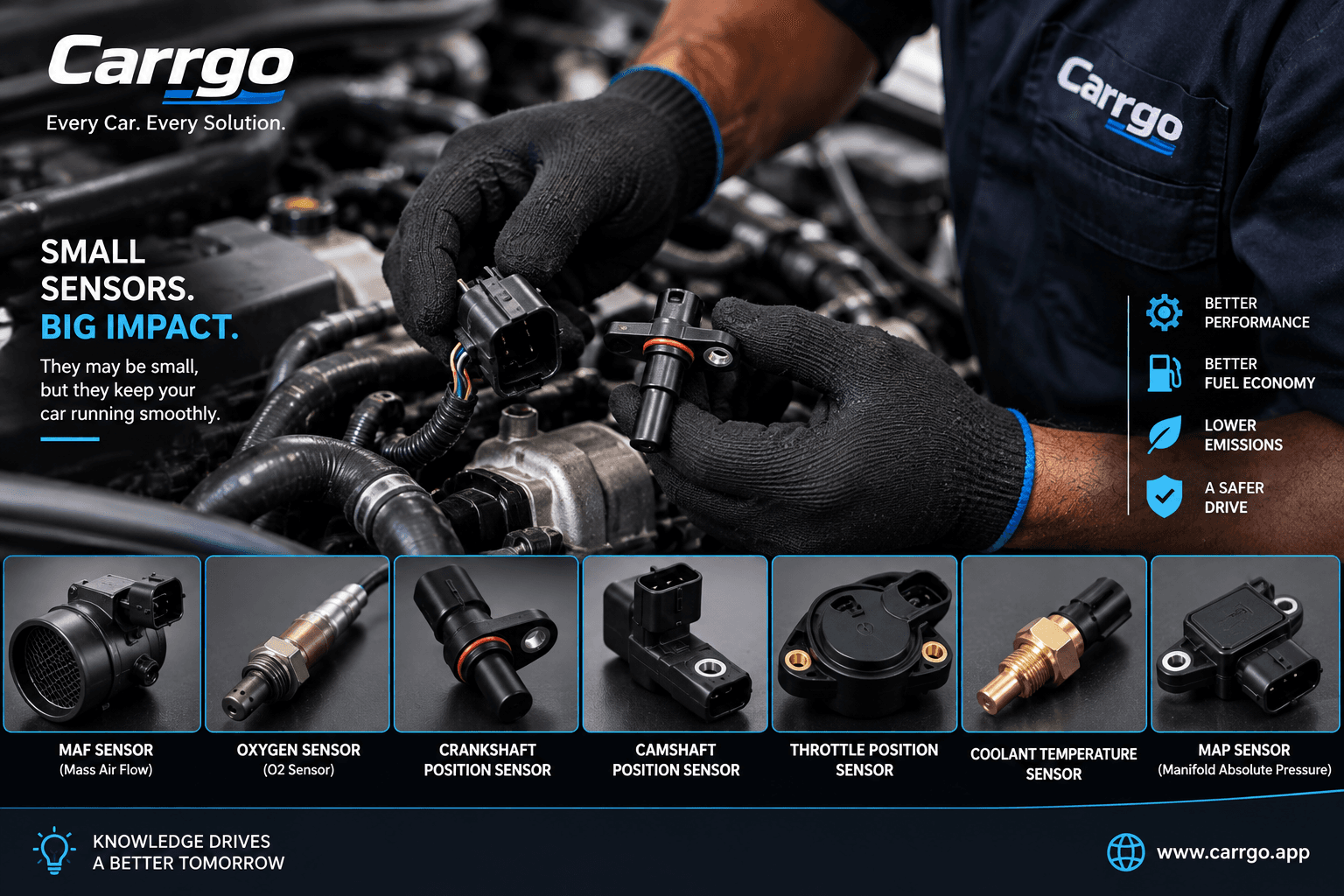
Modern vehicles use many different sensors to monitor things such as engine temperature, air intake, engine speed, throttle position, oxygen levels, wheel speed, and vehicle pressure.
The control system uses this information to make decisions about how different parts of the vehicle should operate.
Why are sensors important?
Modern vehicles rely on accurate sensor information to control engine performance, fuel delivery, emissions, transmission operation, safety systems, and other vehicle functions.
When a sensor provides an incorrect signal or stops communicating, the control module may not have the information it needs to operate the system correctly.
Common sensors found in modern vehicles
- Engine coolant temperature sensor
- Mass air flow sensor
- Manifold absolute pressure sensor
- Throttle position sensor
- Crankshaft position sensor
- Camshaft position sensor
- Oxygen or air-fuel ratio sensors
- Wheel-speed sensors
- Vehicle speed sensor
- Fuel-pressure sensor
- Tyre-pressure monitoring sensors
- Accelerator-pedal position sensor
What happens when a sensor develops a problem?
The symptoms depend on which sensor is affected and how the vehicle's control system responds to the faulty signal.
A sensor problem can sometimes cause noticeable drivability symptoms, while other faults may only trigger a warning light or cause the vehicle to enter a protective operating mode.
- Poor engine performance
- Hard starting
- Engine stalling
- Rough idle
- Poor fuel economy
- Hesitation during acceleration
- Reduced engine power
- Warning lights
- Incorrect temperature or pressure readings
- Transmission or stability-control problems on applicable systems
A sensor code does not always mean the sensor is bad
This is an important part of proper vehicle diagnosis.
A control module may report a sensor-related fault because the signal is outside the expected range. The actual cause could be the sensor, wiring, connector, power supply, ground, mechanical condition, or another system affecting the sensor reading.
Replacing the sensor without testing the circuit and related systems may not solve the problem.
What should be checked during diagnosis?
A proper sensor diagnosis depends on the vehicle and sensor design. Technicians may compare the sensor signal with expected values and check the electrical circuit before deciding whether the sensor itself has failed.
- Sensor power supply where applicable
- Sensor ground where applicable
- Signal wiring
- Connector condition
- Wiring continuity
- Live-data readings
- Sensor signal response
- Mechanical conditions affecting the sensor
- Related diagnostic information
Why sensor maintenance matters
Not every sensor can or should be cleaned. Some sensors can be contaminated by dirt, oil, or other substances, while others are sealed components that require testing and replacement when faulty.
Follow the vehicle manufacturer's service and diagnostic procedures rather than applying the same cleaning method to every sensor.
Do not ignore sensor-related warning signs
A vehicle may continue running even when a sensor has developed a problem, but the underlying fault can affect performance, fuel consumption, emissions, starting, or other vehicle systems.
If a warning light appears or the vehicle begins behaving differently, proper diagnosis can help identify the actual cause before the problem becomes more serious.
Carrgo Technician Tip
Sensors are the information-gathering devices of a modern vehicle.
When a sensor-related problem appears, don't replace the sensor simply because a scan points to it. Test the sensor, its circuit, and the system around it before replacing parts.